
Meta Title: Why Children with Autism Have Delayed Speech | Hope Bridge Autism Centre
Meta Description: Learn why some children with autism experience delayed speech, the causes behind it, and how early speech therapy can help improve communication skills.
Introduction
One of the most common concerns parents have is speech delay. When a child is not speaking as expected for their age, it can be worrying and confusing.
Speech delay is especially common in children with Autism Spectrum Disorder (ASD). However, understanding why it happens can help parents take the right steps toward support and early intervention.
At Hope Bridge Autism Centre, we work closely with families to improve communication skills through personalized therapy programs.
What Is Speech Delay?
Speech delay means a child is not developing spoken language skills at the typical age milestones.
For example:
- No babbling by 12 months
- No single words by 16 months
- No two-word phrases by 24 months
- Limited vocabulary compared to peers
Not every speech delay means autism, but speech delay is one of the early signs seen in many children with autism.
Why Do Some Children with Autism Have Delayed Speech?
Speech delay in autism can happen for several reasons.
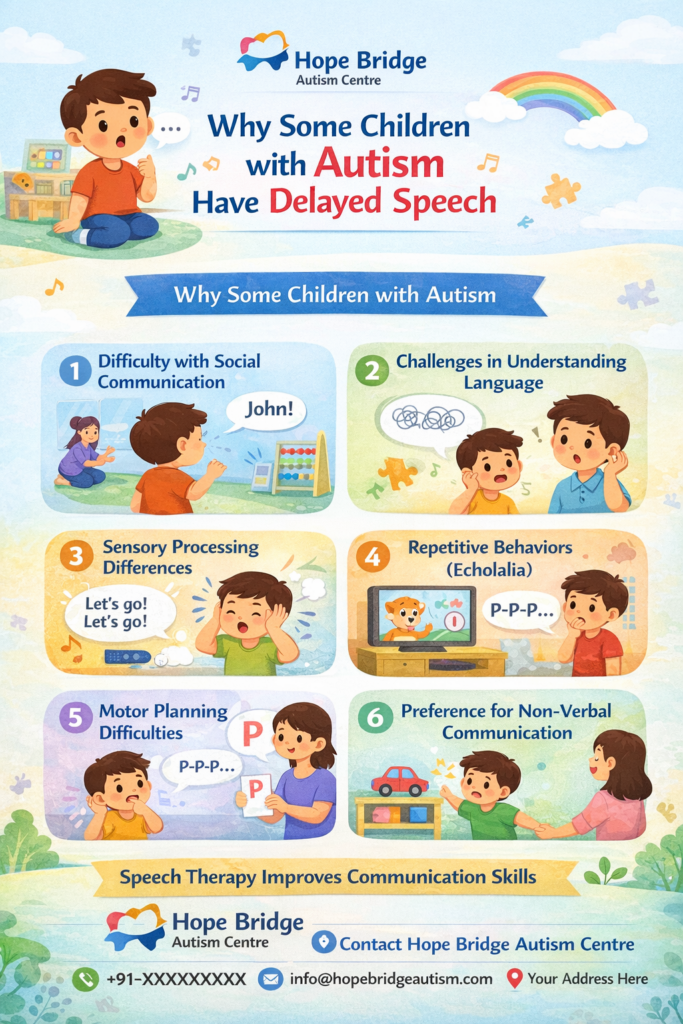
1️⃣ Difficulty with Social Communication
Speech is not just about talking — it is about social interaction.
Children with autism may:
- Have difficulty responding to their name
- Avoid eye contact
- Show less interest in communicating
- Struggle to understand social cues
Since communication is social, challenges in social interaction can delay speech development.
2️⃣ Challenges in Understanding Language
Some children with autism may have difficulty processing or understanding spoken language.
They may:
- Not follow simple instructions
- Seem like they are not listening
- Take longer to respond
If understanding language is difficult, expressing language becomes more challenging too.
3️⃣ Sensory Processing Differences
Children with autism may experience sensory sensitivities.
For example:
- Sounds may feel too loud or overwhelming
- Background noise may distract them
- They may avoid certain sounds
This can make listening and learning language harder.
4️⃣ Repetitive Behaviors (Echolalia)
Some children repeat words or phrases they hear. This is called echolalia.
Instead of using words meaningfully, they may:
- Repeat TV dialogues
- Repeat questions instead of answering
- Use memorized phrases
While echolalia can be part of language development, it may delay conversational speech.
5️⃣ Motor Planning Difficulties
Speech requires coordination of mouth, tongue, and breathing muscles.
Some children with autism may have:
- Difficulty coordinating speech muscles
- Trouble forming clear sounds
- Oral-motor weakness
This can make speaking physically challenging.
6️⃣ Preference for Non-Verbal Communication
Some children with autism may:
- Use gestures instead of words
- Pull parents toward objects
- Communicate through behavior
If their needs are being met without speech, they may not feel motivated to use words.
Is Delayed Speech Always Permanent?
No.
Many children with autism develop speech with the right therapy and support.
Some may:
- Start speaking later than peers
- Use short phrases
- Communicate in unique ways
Every child’s progress is different.
How Speech Therapy Helps
Early speech therapy can significantly improve communication skills.
At Hope Bridge Autism Centre, speech therapy focuses on:
- Improving eye contact
- Building vocabulary
- Encouraging two-way communication
- Teaching functional communication
- Supporting non-verbal children with alternative methods
- Therapy sessions are structured, interactive, and tailored to the child’s needs.
What Parents Can Do at Home
Parents play an important role in speech development.
You can:
✔ Talk to your child frequently
✔ Use simple and clear language
✔ Encourage turn-taking during play
✔ Read picture books daily
✔ Praise communication attempts
✔ Limit screen time
Small daily efforts can make a big difference.
When Should You Seek Help?
Consult a professional if your child:
- Is not speaking by age 2
- Does not respond to their name
- Loses previously learned words
- Shows limited interest in interaction
Early evaluation leads to early support — and early support leads to better outcomes.
Supporting Your Child’s Communication Journey
Speech delay can feel overwhelming, but you are not alone.
With early intervention, patience, and consistent therapy, many children with autism improve their communication skills and gain confidence.
At Hope Bridge Autism Centre, we are committed to helping children express themselves and connect with the world around them.
Conclusion
Speech delay in autism happens due to differences in social communication, sensory processing, language understanding, and motor skills. With professional guidance and structured therapy, children can make meaningful progress.
If you are concerned about your child’s speech development, contact Hope Bridge Autism Centre today for an assessment and personalized therapy plan.